FAQs

Can Tekscan sensors be cut or trimmed?

Question: Can Tekscan sensors be cut or trimmed?

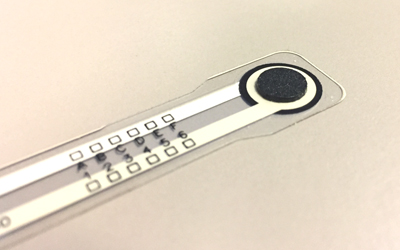
Answer: Yes, some of our sensors can be cut or trimmed to smaller sizes or shapes, or even punctured for secure placement. The model 4205 (pictured), model 7800 pressure sensor and T800 temperature sensor are designed to be sized for custom embedding in battery placements or other tight spots.
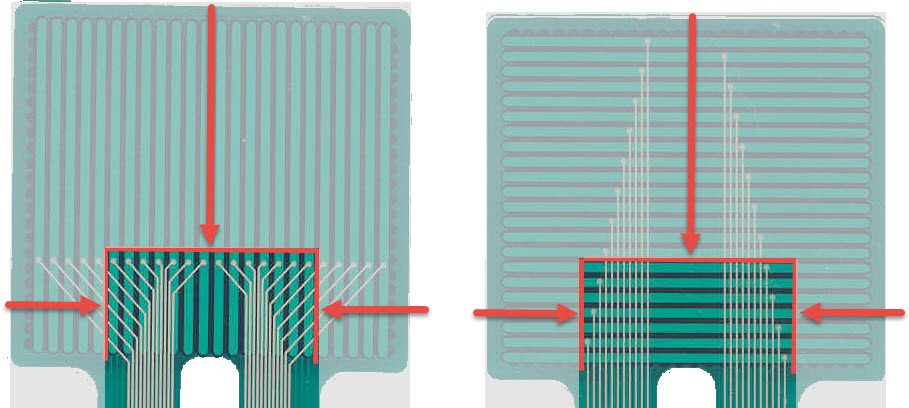
image-20240820133832-1Tips for trimming:

The rows and columns are connected through silver dots and traces on the surface of the sensor. If you trim the sensor, a row or column will remain active so long as the silver dot and silver connecting trace remain intact and connected to the handle.

Based on this photo, you can trim up to 15 rows from the distal end of the sensor before you reach the column trace connections. And you can trim up to 5 columns from either side before you reach the silver connections to the rows.

Consult with a Tekscan engineer if you aren't sure if your sensor is trimmable or how to do it. Cutting through the sensing element will short the sensor! 


---
The ability to trim for shoe size is one of the most important advantages of our in-shoe F-Scan™GO sensor, which can be trimmed to fit any shoe size up to a men’s size 14.

Tips for trimming the F-Scan GO sensor can be found in the manual, or HERE

Link to this FAQ

What sizes are sensors available in?

Question: What sizes are sensors available in?

Answer: We have sensors in many shapes and sizes. Please refer to one of our sensor catalogs to see diagrams of our standard sensors. Contact Tekscan for the sensor that would best fit your application. Custom sensors are also available.

Link to this FAQ

What maintenance do I need to perform on the F-Scan64?

Sensors should always be disinfected with a 70% Isopropyl Alcohol solution after each use. To do this, slightly dampen a cloth with the alcohol solution, careful not to soak or saturate the cloth. Then wipe the sensor. 

Sensors should always be stored flat in either the system box or some other protective cover. Improper storage can adversely affect sensor life. 

Sensor Replacement/Disposal: Always dispose of sensors in accordance with Regional guidelines pertaining to medical biohazardous waste. 

A sensor can be reused either with different subjects after cleaning (requiring the same size sensor) or during a series of tests with the same subject. Sensor life is reduced if the sensor gets wrinkled or folded during use. 

Link to this FAQ

What happens if I go out of Bluetooth range during data collection?

The Bluetooth™ data transfer has a range of 10 m (30 ft.). If the F-Scan64 subject goes beyond the 10m Bluetooth range, there is a buffer of 16,000 frames (for example: @50Hz, recording buffer up to 5 minutes and 20 seconds) that will be stored on the cuffs. Once the subject is back in range, the user can select the “Transfer Recordings” button to re-connect the devices and transfer the collected recording to the PC.   

Link to this FAQ

How long will F-Scan64 sensors last?

Sensor usage is dependent upon application. Typically, you can expect up to up 20 uses, assuming 20-30 steps per trial in-shoe without orthotics. 


Link to this FAQ

Can I purchase only Tekscan sensors?

Question: Can I purchase only Tekscan sensors?

Answer: Tekscan’s patented array or grid sensors are designed to only work with our software and hardware; therefore you cannot simply purchase the sensors unless you own a Tekscan system. We offer single element force sensors that can be purchased without our electronics and software.

Link to this FAQ

How do I clean Tekscan sensors?

Question: How do I clean Tekscan sensors?

Answer: You can wipe our sensors clean with alcohol or water.

Link to this FAQ

What is a puck/shim and do I need to use it?

Question: What is a puck/shim and do I need to use it?

Answer: A puck, otherwise known as a shim or load concentrator, is an object placed between the sensing area and load (like cheese between two pieces of bread) to ensure that the sensor captures 100% of the applied load if the contacting surface is larger than the sensor diameter and to reduce high pressure for point load applications. The applied pressure should be between 1 and 10,000 psi.  If the applied force is small, e.g. 30 grams, a puck should be used to reduce the area to achieve at least 1 psi. For applied loads that are high but have a very small area, a puck should be used to reduce psi to below 10,000. For best results, the loaded area or puck should be between 70% (a diameter of 0.263”, or area of 0.077in2 ) and 100% of the sensing area but can be reduced to achieve results as described above.  Plastic pucks are recommended, as they are pliable but will not deform.

Tekscan offers peel-and-stick delrin pucks for purchase at our online store.

Example of a puck adhered to a FlexiForce A201 sensor.Example of a puck adhered to a FlexiForce A201 sensor.

Link to this FAQ

Is calibration possible for dynamic loads?

Questions: Is calibration possible for dynamic loads?

Answer: Yes.

Link to this FAQ

Do sensors come calibrated?

Question: Do sensors come calibrated?

Answer: No. Sensors should be calibrated by the user with the material (or a material similar) to the one being used in the application.

Link to this FAQ