Skip to main content




Wet-Out Seal Pressure Measurement
Pressure mapping provides significant advantages for industrial wet‑out adhesive sealing applications, where uniform pressure distribution is critical for achieving consistent bond quality, long‑term durability, and process reliability. In applications involving gaskets, tapes, or liquid adhesives that must fully “wet out” a substrate, the pressure applied during assembly determines how well the adhesive flows, fills microscopic surface variations, and develops intimate contact with the mating surfaces. Even small inconsistencies in pressure can produce incomplete wet‑out, leading to voids, delamination, or premature seal failure.
By using the I-Scan pressure‑mapping system, engineers can visually quantify pressure distribution across the entire bond line. This transforms what is normally a hidden interface into measurable data. With that visibility, manufacturers can identify high‑ and low‑pressure zones that would otherwise go undetected. Low‑pressure pockets, for example, often correlate with insufficient adhesive flow or trapped air, while excessive pressure areas may distort components or squeeze out too much adhesive, weakening the seal.
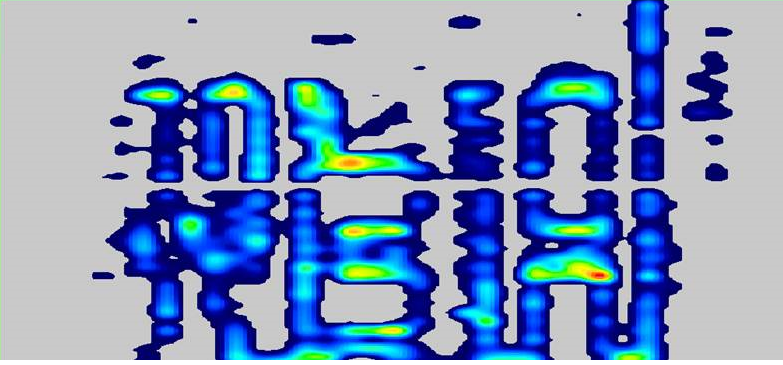 This pressure display shows higher contact toward the middle of this vehicle emblem, but lesser pressure along the edges.
Pressure mapping also accelerates design validation and process optimization. During prototyping, engineers can quickly iterate clamp designs, fastening strategies, or surface geometries and immediately see the effects on seal uniformity. In production, pressure mapping supports quality assurance by verifying that tools and fixtures apply pressure as intended, even as components vary batch to batch. This reduces scrap, rework, and the risk of field failures.
This gives you the ability to create repeatable, data‑driven assembly procedures. Once optimal pressure profiles are identified, they can be documented and monitored over time, helping ensure consistency across operators, shifts, or manufacturing sites. This level of process control is especially valuable in high‑performance industries such as automotive, aerospace, electronics, and energy systems, where adhesive seals must withstand thermal cycling, vibration, and environmental exposure.
Overall, pressure mapping strengthens adhesive wet‑out performance, improves seal reliability, and enhances operational efficiency—ultimately leading to higher‑quality products and more robust manufacturing processes.
Benefits of Using I-Scan Pressure Mapping
- Improve quality of the seal over the entire bond line
- Reduce scrap and failure rate
- Automate and speed up fastening process
See how Pressure Mapping can help validate a tight seal on any product or device: