 Skip to main content

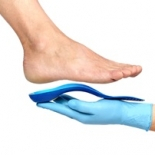
Patient with Plantar Fasciitis, Functional Hallux Limitus and Limb Length Difference
by Bruce E. Williams, DPM
Merrillville, IN
www.breakthroughpodiatry.com
Plantar fasciitis is one of the most commonly seen problems in a podiatrist's office. The use of custom foot orthotics to treat this plantar fasciitis is quite commonplace. But what exactly goes on inside the shoe before and after the use of custom orthotics? Why do some orthotics fail? Being able to use the F-Scan™ to identify asymmetries in function before treatment and to fine tune the orthotics after treatment is invaluable. By using F-Scan, you can easily identify other common problems, such as functional hallux limitus and limb length differences. Then, by addressing and modifying the orthotic to compensate for these problems, the orthotic outcomes will be improved.
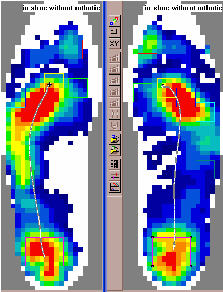
Pressure Profile Without Orthotics
To the left are the F-Scan pressure profiles for a patient with a history of plantar fasciitis in the right foot. Note the loss of 1st metarsal head pressures. This is an indication of functional hallux limitus (FnHL). Note the lateral deviation of the center of force (gray line), again an indication of FnHL.
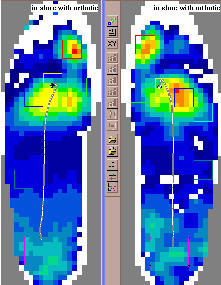
Pressure Profile With Orthotics
In the pressure profiles to the right, the patient has custom foot orthotics with a ¼" heel lift on the left and no 1st ray cutouts. Notice the improvement in the midline position for the center of force, and an increase in the sub 1st met head pressures. Also, the hallux pressures have increased, which is not always desired.
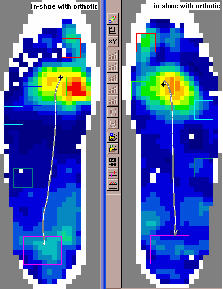
Pressure Profile With Final Orthotics
The patient has the same orthotics, but with ¼" heel lifts and 1st ray cutouts bilateral. Notice the decrease in the hallux pressures bilateral, with the continued good sub 1st met head pressures. With this prescription, the patients symptoms of fasciitis completely resolved in just a few visits and all without the need for injected steroids.
Summary
When using F-Scan to evaluate custom foot orthotic outcomes, you want to focus on a few specific things. Initially, you want to watch for the progression of the Center of Force (gray icon and trailing line). The ideal progression of this line is midline on the foot, from the heel to the 2nd metatarsal head, or slightly lateral of this point. Second, you want to check for pressures of the 1st metatarsal head. Ideally, you want moderated pressures at the metatarsal heads 1-5, with good pressures sub 1st met head bilateral. Finally, you want to watch for equal loss of pressure at the heel bilaterally. If one foot is accelerating faster than the other foot, you will often see a loss of heel pressure on the faster foot. This is often (but not always) an indication of a short limb. The use of heel lift on this short limb will often bring symmetry to the foot function, along with the modifications discussed above.

