 Skip to main content

Sensors Measure the Force of CPR Compressions
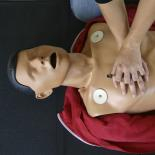
Challenge: Cardiopulmonary resuscitation (CPR) is a lifesaving technique practiced by millions of people each year. Chest compression, sometimes referred to as artificial circulation, is done by pumping the chest to circulate oxygenated blood throughout the body. Three factors of chest compressions are crucial to the overall technique: hand placement, depth of compression, and compression rate. The purpose of hand placement, or landmarking, is to target compressions to the most effective area of the chest without causing injury. Team iDoll, from University of British Columbia, asserts that CPR is often poorly executed as a significant percentage of CPR trainees lack the confidence and ability to perform CPR during actual life-threatening scenarios. Hence, Team iDoll sought to develop a system that would improve the CPR training paradigm.
Solution: Team iDoll developed a system that can be economically integrated into manikins for self-guided or classroom-based CPR training programs. The system provides interactive features such as technique assessment and vital sign simulations, as well as other features that improve students' self-learning and help instructors manage multiple students in classroom settings. Tekscan's FlexiForce™ A201 force sensors assist in the process by pinpointing the pressure points of hand compressions applied by students while performing CPR. The thin, flexible design of the sensors allowed them to be easily integrated into the system to determine hand placement position. For compression depth, the team considered a variety of alternatives, including optical sensors, potentiometers, and magnetic coils. Since force sensors were already chosen for hand placement, team iDoll determined that the rough relationship of force to depth could be used to estimate the compression depth.
In their prototype, Team iDoll selected an accelerometer to use with the FlexiForce A201 force sensors to evaluate chest compressions. They calculated that the maximum downward acceleration caused by human compression would not exceed 1.5 grams on these CPR manikin models. For the prototype, they used two of Tekscan's standard off-the-shelf A201-25 sensors.
Benefits of FlexiForce™ Sensors
- Ultra-thin sensor construction and flexibility means minimal interference/disturbance to normal action
- Accurate response gives your customers and end users confidence in the performance of your product
- Knowledgeable, experienced technical staff help you develop the most effective, economical sensor based on your specific requirements. All manufacturing takes place at ISO 9001 compliant & 13485 registered Tekscan headquarters.
- 100% factory inspection ensures your sensors meet established performance specifications
Getting Started with FlexiForce Sensors
FlexiForce sensors are available off-the-shelf in packs of four or eight for testing and prototyping. Visit our online store to place an order, or contact us to discuss customization options with one of our engineers.


